Banking & financial services
Keep pace with every rule, and prove your people can apply it
Regulation and AI are reshaping banking roles faster than the annual review. Opigno shows what each person can do, anticipates what their role will require, and turns every new obligation into targeted training your compliance team can sign off.

Skills analytics (Top 10 by points)
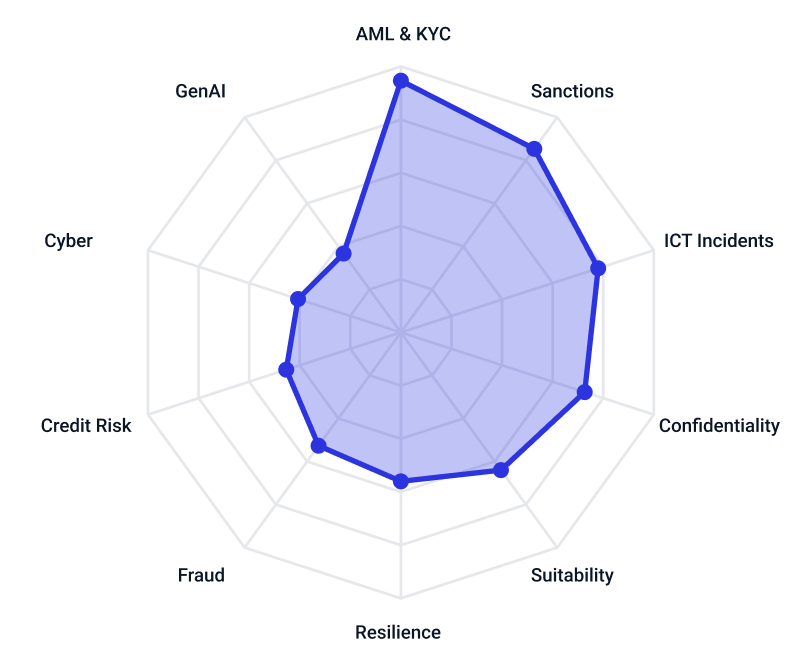
| # | Skill | Points |
|---|---|---|
| 1 | AML & KYC Controls | 142 |
| 2 | Sanctions Screening | 128 |
| 3 | ICT Incident Reporting | 117 |
| 4 | Client Data Confidentiality | 109 |
| 5 | Suitability & FinSA Conduct | 96 |
The load is growing
Compliance now takes a larger share of every bank
61%
Rise in compliance hours at large banks from 2016 to 2023, while total employee hours grew only 20%.
24% → 42%
Share of C-suite time spent on compliance, 2016 vs 2023.
27% → 43%
Share of board time spent on compliance, 2016 vs 2023.
Source: Bank Policy Institute, Compliance Resource Survey (October 2024), 20 large banks operating in the US.
Sound familiar?
“Every new circular means another campaign for everyone.”
The same mandatory module goes to thousands of people, when only a few hundred roles are actually affected by the change.
“We can prove completion. Not competence.”
A completed e-learning shows a date. It doesn't show that an advisor can spot a red flag or that a team can follow the incident chain.
“Training, monitoring and reporting live in three systems.”
Every audit starts with exports and spreadsheets, and the gaps between systems are where findings appear.
“Roles are changing faster than our skills framework.”
AI and new products reshape front, middle and back office. Knowing who is ready, and who will need to be, is still guesswork.
How it works
From new obligation to verified competence
Detect
When a rule, policy or sanctions list changes, Opigno identifies which roles, entities and jurisdictions are affected, and what changed for them.
Teach
Each person gets training on what changed for their role, not the whole policy again, in their language.
Verify
Clara checks that the change was understood and can be applied. Your compliance team decides where a human signs off.
Measure again
Skills and compliance status update per person, and the second line gets audit-ready evidence on demand.
Your compliance and L&D teams configure the agents — which sources they watch, who must validate, and where the evidence goes.
What banks use Opigno for
| Use case | What changes for you |
|---|---|
| Mandatory compliance training | AML, sanctions, conduct and data protection assigned by role and risk, and refreshed when the rules change. |
| Regulatory change | FINMA circulars, DORA, AMLA or FinSA updates turned into targeted training for the roles they actually affect. |
| Operational resilience | Teams kept trained on incident-reporting chains, with readiness evidence for supervisors. |
| Audits and supervisory reviews | Show who is trained and competent, on which version of which rule, with the evidence behind it. |
| Skills for changing roles | See what advisors, operations and IT teams can do today, and anticipate what their roles will require. |
| Onboarding | New hires start from what they already know and reach full competence sooner, in every entity. |
Built for how a bank works
Governed agents
Guardrails, full action logs and human sign-off on every agent. Nothing is certified by AI alone.
Connected to your stack
Opigno reads roles from your HRIS and obligations from your GRC tools, and writes competence evidence back.
Your models, your data
Hosted in Switzerland or in your own data centre, with the AI models your bank has already approved.
Questions we hear often
Can Opigno work with our GRC and HR systems?
Yes. Opigno connects through open APIs and MCP, so a change in your regulatory inventory can trigger the loop, and evidence flows back.
Does the AI decide who is certified?
No. Your compliance team decides which steps need human validation and who gives it. The AI never certifies anyone on its own.
Can each entity and jurisdiction keep its own rules?
Yes. Each entity has its own space, rules and languages, under one governance and one consolidated view.
Where is our data hosted?
In Switzerland by default, or on your own infrastructure. Your data is never used to train AI models.
Start with one obligation.
Bring a requirement you're managing today, such as a FINMA circular or a DORA obligation. In a working session, we'll show who it affects, what they need to learn and how you'd prove it.
Talk to us