How it works
Detect. Teach. Verify. Measure again
Opigno is a Learning Intelligence Platform. It runs one continuous loop that connects what your organisation needs, what your people can do and what you train, and keeps them in step.
Training has always been a one-way street
A course is assigned, completed and reported, and nobody knows whether anything changed. The loop closes that gap: every piece of learning starts from a measured gap and ends with a verified result, which becomes the starting point for the next one.
The four steps
Detect the gap
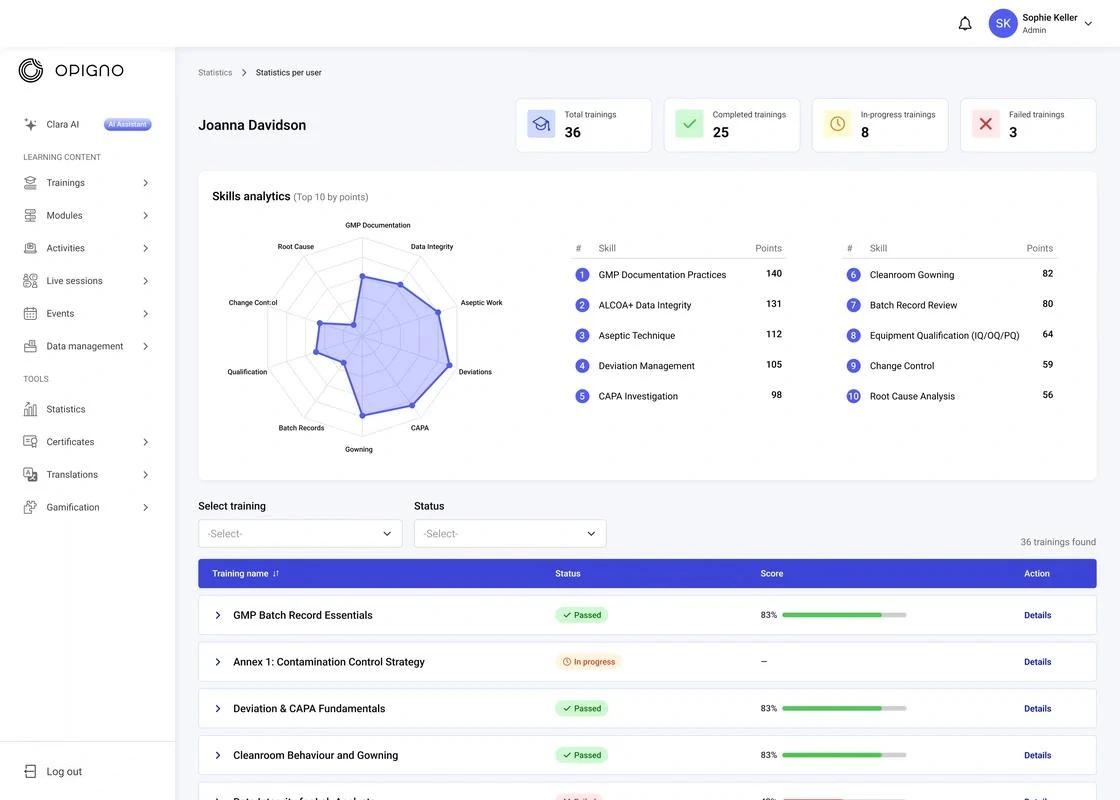
Opigno reads the signals already in your systems and builds a live profile of what each person can do, compared with what their role requires.
Teach against it
Instruction is generated from your own content and adapted to each person's gap, role and language. Your SCORM courses fit in too.
Verify what was learned
Clara checks understanding and application, not just completion. Where you require it, a person validates the practical step.
Measure again
Verified capability updates the profile and flows back into your HR systems. The next gap is already in view.
Who does the work
Agents run the loop. Your team stays in control.
A set of specialised AI agents handles each step: profiling learners, generating content, adapting the teaching approach, coaching, translating and handling routine administration. Your team decides what each agent can see and do, and where a person must sign off.
Explore AI agents →How Opigno compares
| LMS | LXP | Opigno (LIP) | |
|---|---|---|---|
| Starts from | A course catalogue | Learner interests | A measured skills gap |
| Measures | Completion | Engagement | Verified capability |
| Content | Uploaded by admins | Curated and recommended | Generated from your own sources and adapted per person |
| Result | Training records | Activity data | A live picture of what people can do |
- Starts from
- A course catalogue
- Measures
- Completion
- Content
- Uploaded by admins
- Result
- Training records
Grounded in learning science
Clara's pedagogy draws on research in learning technologies. Our scientific advisory board includes Prof. Pierre Dillenbourg (EPFL), a leading researcher in the field.