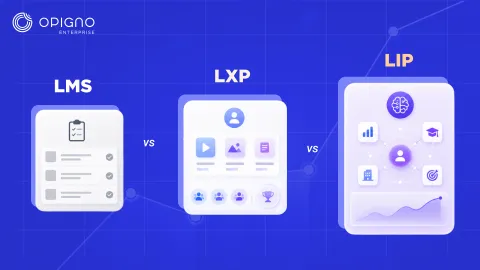


Learning management systems have been the backbone of corporate training for decades. They store content, track completions, and generate compliance reports. For simple, stable training needs, they do the job.
But the world of work has changed. Organizations now operate across multiple regions, manage rapidly evolving skill requirements, and expect their learning to connect with other functions — not sit in isolation. For many L&D teams, the traditional LMS has turned from an enabler to a bottleneck, and the market has responded with many alternatives and add-ons. Let's go over each, explore where they fit, and why the Learning Intelligence Platform (LIP) — as embodied by Opigno Enterprise — answers a problem the other categories leave open.
For a vendor-by-vendor view of how the leading platforms compare on AI maturity, integration depth and fit, see our comparison of 10 AI learning platforms for enterprise.
eLearning Authoring Tools
Authoring platforms help teams build structured digital content — courses, modules, assessments — without specialist technical skills. Modern tools support branching scenarios, interactive simulations, SCORM/xAPI output, and AI-assisted content generation.
They are purpose-built for content creation, not delivery or management. Most organizations use them alongside an LMS or LXP — the authoring tool builds the course, a separate platform delivers and tracks it.
Microlearning Platforms
Microlearning platforms deliver training in short, focused bursts optimized for mobile and daily work rhythms. They are highly effective for reinforcing knowledge, providing behavioral nudges, and keeping skills fresh after a longer program.
They work best as a complement to a core learning platform rather than a standalone solution — excelling at the "last mile" of retention rather than the full training lifecycle.
Learning Experience Platforms (LXP)
LXPs put content discovery and self-directed learning at the center. Learners browse curated libraries, follow peer recommendations, and build their own paths. Modern LXPs have matured significantly — many include AI-driven recommendations, social learning features, and HR system integrations.
They shine when the goal is a culture of continuous, self-directed learning, but are more limited in structured compliance management, and the centralized administrative oversight that regulated industries require.
Skills Intelligence Platforms
Skills intelligence platforms map what employees know against what roles require, surface gaps, and connect development activities to workforce planning. The best aggregate data from assessments, job profiles, and project histories to give L&D and HR leaders genuinely useful strategic intelligence.
Most organizations deploy them as a planning layer that informs decisions made in other systems. The value is in the insight; acting on it still requires connecting to wherever learning actually happens.
HR Onboarding and Employee Experience Platforms
Modern onboarding platforms orchestrate the full new-hire experience — structured task flows, manager check-ins, culture content, early performance milestones — and many have expanded into broader employee experience management.
Their focus remains on the employee relationship and experience journey rather than learning management. Organizations typically run them in parallel with a dedicated learning platform: onboarding handles the experience layer, while the LMS or LIP handles formal training, certification, and compliance tracking.
Workflow Learning Platforms
Workflow learning platforms embed guidance directly into the systems employees use day-to-day — prompts, walkthroughs, and contextual knowledge surfaced at the moment of need inside enterprise software. The best implementations effectively eliminate the gap between training and application.
They are most valuable for process-heavy roles and typically operate as one layer within a broader learning ecosystem, complementing formal training rather than replacing it.
The Real Cost of Building a Stack
Each platform category above solves a real problem well. Many organizations run several of them in combination, and it works, up to a point.
The hidden cost is in the seams. An authoring tool produces content that needs to be manually imported elsewhere. A skills platform surfaces gaps that someone has to translate into enrollments in a different system. An LXP generates engagement data that never reaches the compliance dashboard. Onboarding flows hand off to an LMS with no shared context. Each new tool added to the stack creates new integration work, new data reconciliation, and new places where things fall through.
For smaller or simpler learning operations, that overhead is manageable. For enterprises running training across regions, regulatory frameworks, and diverse audiences, it becomes a significant drag on administrator time, on reporting accuracy, and on the ability to respond quickly when organizational needs change. That's the problem a Learning Intelligence Platform is designed to solve.
What Is a Learning Intelligence Platform (LIP)?
A Learning Intelligence Platform combines structured learning management, personalized experience delivery, advanced analytics, and intelligent automation in a single unified architecture. The "intelligence" layer sets it apart from a feature-rich LMS. It connects data across the entire learning function and business systems, aligns learning with corporate processes, and gives administrators a complete, actionable picture they could never assemble manually from separate tools. On top of that, AI agents let teams manage those processes more efficiently.
Rather than replacing L&D judgment, a LIP extends its reach. The goal is to embed learning into how the organization actually operates, and to make its effects measurable — rather than simply tracking course completions.
Opigno Enterprise: Built to Bridge
Opigno Enterprise is a Learning Intelligence Platform, with AI operating across authoring, delivery, analytics, and integration as a coherent whole.
One Platform Across the Full Learning Lifecycle
Opigno Enterprise covers structured course delivery, self-directed learning, social learning, compliance management, and certification in a single environment. Content authored in the platform is delivered, tracked, and analyzed there too — with no hand-offs between systems and no data lost in translation. For organizations running multiple audiences or business units, the multi-tenant architecture gives each environment its own branding, content, user roles, and compliance settings while maintaining centralized oversight across all of them.
All of this runs under the full supervision of L&D teams — every path, rule, and workflow is configured by the people responsible for learning, and the platform executes their decisions at scale.
Connected to the Business, Not Just the LMS
Opigno Enterprise goes beyond a conventional LMS in the depth of its integration with the rest of the organization. Via native integrations with HRIS, CRM, and ERP systems, the platform draws on live business data to inform learning decisions — and feeds learning outcomes back into business reporting.
In practice, this opens up use cases that are simply out of reach for a standalone LMS. When a sales team's CRM data shows declining pipeline performance in a product area, a targeted training sequence can be triggered. When HRIS signals a wave of promotions into management roles, onboarding paths deploy before the first day in the new position. When a field team's compliance certifications are mapped against an upcoming regulatory audit date, the platform surfaces exactly who needs what and by when — across every region simultaneously. When a customer success team's support ticket data reveals recurring knowledge gaps, L&D can identify and close them before they affect renewal rates.
AI-Assisted Authoring and Translation
The AI authoring engine generates structured course drafts from existing documents — PDFs, presentations, Word files — producing module outlines, learning objectives, and quiz questions in a fraction of the time manual authoring requires. Content is generated across 50+ languages simultaneously, with subject-matter expert review before publication. L&D teams retain full editorial control throughout, and customer data is never used to train external AI models.
Clara: Conversational Access to Learning Data
Clara is Opigno Enterprise's AI assistant. For learners, it answers questions, surfaces relevant resources, supports navigation, and delivers personalized coaching — adapting guidance to individual progress and helping people develop through conversation.
For administrators, it provides conversational access to live platform data — ask which teams are behind on mandatory training, which modules have the lowest completion rates, or which employees in a given region lack a certification required for an upcoming product launch, and get an immediate answer drawn from live data across all connected systems. Clara goes beyond reporting: it can manage enrolments, update training content, and handle catalog administration — all through natural language, without navigating menus or writing configuration rules.
Configurable Automation
Opigno Enterprise supports configurable, automated workflows built using Opigno's Agent Builder — a visual configuration environment where L&D teams design automation rules in plain language, without writing code. Agents can span connected systems: triggering a training sequence in response to an HRIS event, escalating to a manager via email when a deadline is missed, or updating a CRM record when a certification is completed. AI features are modular and can be enabled, disabled, or scoped by tenant and user role, giving regulated organizations the governance controls they need.
LMS vs LXP vs LIP: A Clear Comparison
Capability
| Traditional LMS
| LXP
| Opigno Enterprise LIP
|
|---|---|---|---|
| Structured course delivery | ✓ | Partial | ✓ |
| Learner-driven content discovery | Limited | ✓ | ✓ |
| AI-assisted personalization | Varies | ✓ | ✓ |
| AI-assisted course authoring | Varies | Varies | ✓ |
| HRIS / ERP / CRM integration | ✓ | ✓ | ✓ (native, API-first) |
| Cross-system analytics and triggers | Limited | Limited | ✓ |
| Configurable automated workflows | Varies | Limited | ✓ |
| Multilingual AI translation | Varies | Varies | ✓ (50+ languages) |
| Multi-tenant architecture | Varies | Varies | ✓ |
| Granular AI feature governance | Varies | Varies | ✓ (per tenant / role) |
Finding the Right Fit for Your Organization
Opigno Enterprise is well-suited to organizations looking to increase the efficiency of their L&D function — whether that means adding a powerful intelligence layer on top of an existing stack, consolidating tools over time, or starting fresh with a unified platform. It is a particularly strong fit for:
- Enterprises managing training across multiple regions, subsidiaries, or regulatory environments that need centralized control without losing local flexibility
- Organizations in regulated industries — pharma, healthcare, financial services — where compliance training must be accurate, auditable, and tightly governed
- L&D teams looking to reduce time spent on manual administration and invest more in strategy and content quality
- Companies that want training outcomes connected to business KPIs, not just completion statistics
- Any organization where skill gaps are a strategic risk, and managers need real-time visibility to act on them
Most organizations already have a learning stack that works to some degree. Opigno Enterprise is designed to fit into that reality — it can operate alongside existing tools, layering agent-driven automation and cross-system intelligence on top of what is already in place — no forced migration and no disruption to ongoing programs. The starting point is simply better visibility, less manual work, processes that finally connect to the wider business, and gaining capabilities your current stack cannot provide: agent-driven automation, cross-system analytics, and an L&D team that spends less time on administration.
See what Opigno surfaces in your own organization. Request a demo — a short working session using one of your business units and your existing competency framework.