

There's a growing gap in how organizations experience AI in their learning platforms — and it has nothing to do with which AI model is running under the hood.
On one side, you have platforms that have added AI capabilities: a chatbot here, a content generator there, maybe an auto-translation button. These features can be genuinely useful. But they share a structural limitation: each one operates in isolation, working only from the data available within its narrow scope. A quiz generator sees the content in front of it. A learning path recommender sees completion data. Insights from one feature don't inform another. The AI isn't building a richer picture over time — it's responding to isolated inputs.
None of this is a failing of the AI technology itself. It's a structural limitation of retrofitting intelligence onto an architecture that wasn't designed for it.
On the other side, you have platforms where AI is embedded across the full system — connected to a shared data layer, aware of organizational context, and able to act on signals that span the entire learning lifecycle.
That distinction — fragmented versus contextually aware — is the real difference between AI-enhanced and agentic.
What "agentic" means in practice
We covered the definition in our previous article. But what does agentic AI look like when it's working across an entire platform?
Think about what happens when a company promotes an employee. In a traditional LMS, someone in HR updates the org chart. Someone in L&D notices — days or weeks later — and manually assigns new training. The employee might go weeks without the compliance modules required for their new role.
On a platform with embedded agentic AI, the moment the HRIS records the role change, the AI agent detects it, cross-references the new role's training requirements, launches the appropriate onboarding sequence, notifies the manager, and flags any compliance certification gaps that must be closed within a specific window. The AI has the full context to act appropriately — the role change, the compliance requirements, the learner's existing certifications — because all of that lives in a unified data layer it can read.
That's not a feature. That's a different model for how learning operations work.
The dimensions that actually separate them
Context is one axis, but it's not the only one. The differences between plugged-on and embedded AI compound across several dimensions that matter to how a learning platform performs over time.
If you want to see where individual vendors currently sit on these dimensions, our comparison of 10 AI learning platforms for enterprise assesses each one on whether its AI assists or acts.
Context. Add-on AI features work from the data they can directly see — content, completion records, quiz scores. Embedded AI draws on the full organizational picture: role data, performance signals, compliance requirements, HR events. The gap isn't just about what the AI knows — it's about whether it knows enough to act meaningfully.
Memory and improvement. Siloed AI has no continuity between interactions. Embedded AI accumulates: it tracks how individuals and teams develop over time, notices patterns — a persistent skill gap, a training intervention that isn't moving the needle — and adjusts. This is the difference between a tool that responds and a system that learns.
Compliance monitoring. Regulations change. When a compliance standard is revised, an AI agent with access to both the regulatory signal and the learner population data can flag affected content, identify who is impacted, and trigger review and re-enrollment workflows — without waiting for someone to run a manual audit. A siloed feature can't do this: it doesn't have access to the regulatory signal, and even if it did, it couldn't connect it to the right people.
Role-aware personalization. Meaningful personalization requires the AI to understand role data, business context, and content simultaneously. When those data sources are connected, the platform can ensure each learner receives training that reflects not just what they've done before, but what their role actually requires of them now.
Skill gap detection before performance suffers. By cross-referencing learning data with performance signals from connected business systems, AI agents can identify capability gaps at the team or department level — before they manifest as missed targets or audit findings. Add-on AI can surface patterns within the LMS; it can't correlate them with what's happening outside it.
Auditability. When a siloed AI feature produces a poor recommendation, it fails silently — the output just goes unnoticed or unused. Embedded AI operates within a system that knows what happened before and after each action, making its decisions traceable and accountable. In compliance-heavy environments, this distinction carries real weight.
Operational and vendor overhead. Plugged-on AI typically introduces integration seams that require ongoing maintenance — API changes, data format drift, version mismatches. Each point solution comes with its own contract, data agreement, and failure mode. Embedded AI eliminates that seam by design, and consolidates the vendor surface area to a single platform that IT and procurement actually want to manage.
The architecture question
A platform where agentic AI works across the entire learning lifecycle — from content creation to learner support to compliance management to strategic analytics — needs a unified data layer that all those agents can read and write to, integrated with the systems where the organizational context lives, and able to respond to events occurring elsewhere in the business, not just within the LMS itself.
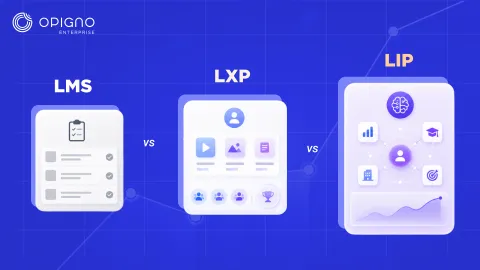
When Opigno Enterprise describes itself as a Learning Intelligence Platform rather than an AI-enhanced LMS, this is what that means in concrete terms. Clara, the platform's AI agent, isn't a chatbot sitting on top of the system — it's connected to the full data layer, able to answer questions like "which teams in our EMEA region have the highest compliance risk in the next 90 days?" because it has access to live certification data, role information from connected HR systems, and historical completion patterns, simultaneously.
What this means for L&D teams
For learning and development professionals, the practical implication is a shift in what their role actually involves.
In an AI-enhanced LMS, L&D teams spend significant time on tasks that are, at their core, information routing: identifying who needs what training, making sure the right content exists, chasing completion, and building reports. AI tools can speed some of this up, but the coordination work is still fundamentally theirs — because the AI doesn't have the context to close the loop itself.
In a platform with embedded agentic AI, the routine coordination happens within the system, because the AI has access to everything it needs to act appropriately. The L&D team's attention gets freed for the work that actually requires human judgment: understanding business strategy, interpreting nuanced performance signals, making decisions about how to develop organizational capability over time.
This ensures that humans in the loop are focused on decisions that genuinely need them.
The question worth asking
If you're evaluating AI capabilities in learning platforms — or reassessing what your current platform actually delivers — the question worth asking is how much context does the AI actually have?
Does it connect to where your organizational data actually lives, or does it work from within the LMS bubble? Can it cross-reference a role change in your HRIS with a compliance gap in your training data? Does it build a richer picture of your organization over time, or start fresh with every interaction?
The answers tell you whether you're looking at AI as a collection of features or as an intelligence layer that spans your entire learning ecosystem. That distinction will matter more, not less, as organizations grow more complex and the expectations on learning functions continue to rise.
Opigno Enterprise is built around embedded agentic AI — connected to the full organizational context rather than operating in isolation. To see how this works in practice, book a demo with our team.